The Anthropocene Reviewed by John Green
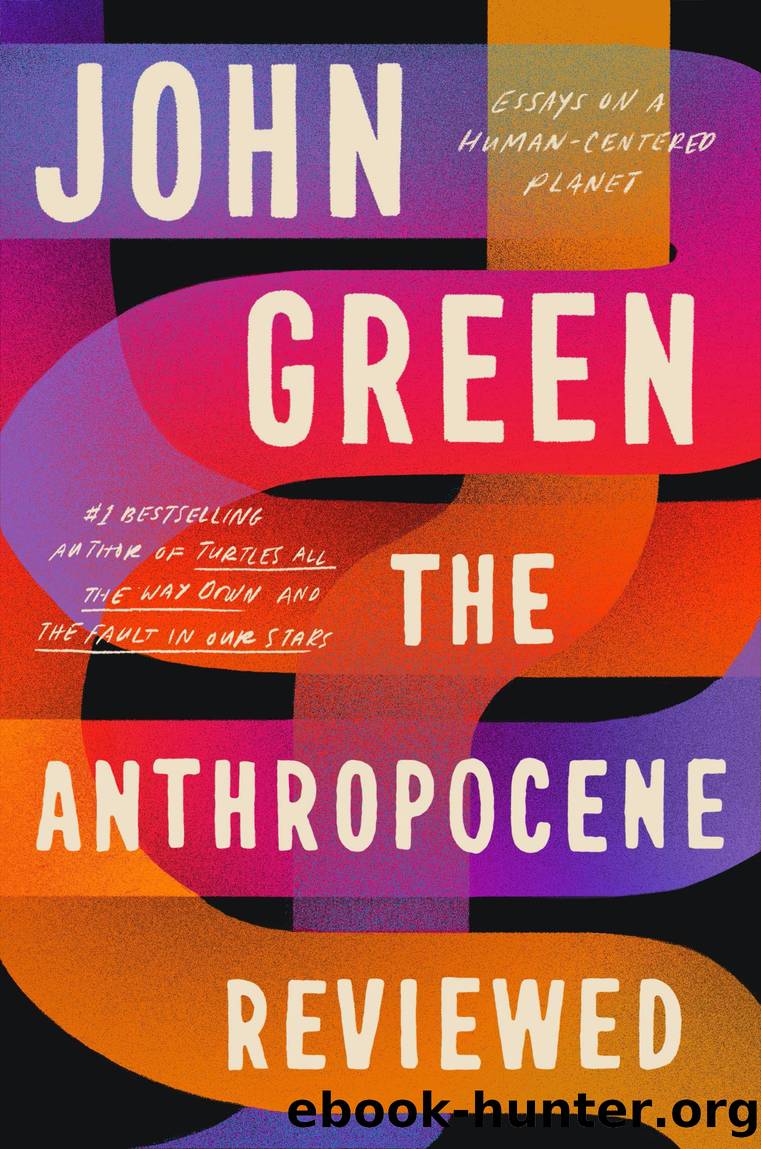
Author:John Green [Green, John]
Language: eng
Format: epub
Publisher: Penguin Publishing Group
Published: 2021-05-18T00:00:00+00:00
âAuld Lang Syneâ was a popular song during World War Iâversions of it were sung in trenches not just by British soldiers, but by French and German and Austrian ones as well, and the song even played a small role in one of the strangest and most beautiful moments in world history, the Christmas Truce of 1914.
On Christmas Eve that year, along part of the warâs Western Front in Belgium, around one hundred thousand British and German troops emerged from their trenches and met one another in the so-called no-manâs-land between front lines. Nineteen-year-old Henry Williamson wrote his mother, âYesterday the British and Germans met and shook hands in the ground between the trenches and exchanged souvenirs . . . Marvellous, isnât it?â A German soldier remembered that a British soldier âbrought a soccer ball from their trenches, and pretty soon a lively game ensued. How marvelously wonderful, yet how strange it was.â Elsewhere on the front, Captain Sir Edward Hulse recalled a Christmas sing-along that âended up with âAuld Lang Syneâ which we all, English, Scots, Irish, Prussians, Wuttenbergers, etc., joined in. It was absolutely astounding, and if I had seen it on a cinematograph film I should have sworn that it was faked.â
Hulse, who was twenty-five years old at the time, would be killed on the Western Front less than four months later. At least seventeen million people would die as a direct result of the warâmore than half the current population of Canada. By Christmas of 1916, soldiers didnât want trucesâthe devastating losses of the war, and the growing use of poison gas, had embittered the combatants. But many also had no idea why they were fighting and dying for tiny patches of ground so far from home. In the British trenches, soldiers began to sing the tune of âAuld Lang Syneâ with different words: âWeâre here because weâre here because weâre here because weâre here.â
Here was a world without whys, where life was meaninglessness all the way down. Modernity had come to war, and to the rest of life. The art critic Robert Hughes once referred to the âpeculiarly modernist Hell of repetition,â and the trenches of World War I were hell indeed.
Download
This site does not store any files on its server. We only index and link to content provided by other sites. Please contact the content providers to delete copyright contents if any and email us, we'll remove relevant links or contents immediately.
| Anthropology | Archaeology |
| Philosophy | Politics & Government |
| Social Sciences | Sociology |
| Women's Studies |
The remains of the day by Kazuo Ishiguro(8964)
Tools of Titans by Timothy Ferriss(8359)
Giovanni's Room by James Baldwin(7315)
The Black Swan by Nassim Nicholas Taleb(7097)
Inner Engineering: A Yogi's Guide to Joy by Sadhguru(6783)
The Way of Zen by Alan W. Watts(6590)
Asking the Right Questions: A Guide to Critical Thinking by M. Neil Browne & Stuart M. Keeley(5751)
The Power of Now: A Guide to Spiritual Enlightenment by Eckhart Tolle(5741)
The Six Wives Of Henry VIII (WOMEN IN HISTORY) by Fraser Antonia(5493)
Astrophysics for People in a Hurry by Neil DeGrasse Tyson(5172)
Housekeeping by Marilynne Robinson(4433)
12 Rules for Life by Jordan B. Peterson(4298)
Double Down (Diary of a Wimpy Kid Book 11) by Jeff Kinney(4257)
The Ethical Slut by Janet W. Hardy(4236)
Skin in the Game by Nassim Nicholas Taleb(4232)
Ikigai by Héctor García & Francesc Miralles(4229)
The Art of Happiness by The Dalai Lama(4118)
Skin in the Game: Hidden Asymmetries in Daily Life by Nassim Nicholas Taleb(3986)
Walking by Henry David Thoreau(3949)
